
Dear Professor X
As you may know, NEC Research Institute, now NEC Labs, began CiteSeer servicing in 1998 for computer and information scientists to perform citation-context tracking (CCT) better than their manual way. Google Scholar, Microsoft Academic, and many others followed. It was granted a US patent for automating the organization of citation-context database (CCD), but not for the principle of citation-context indexing (CCI). If CiteSeer had been patented for that principle, the others might not have emerged.
Meanwhile, I proposed that principle in 1974 in my MSc thesis submitted to University College London. I was supervised by Bertram Brookes, under whom Stephen Robertson and Nicholas Belkin were doctoral students. In 1975, they made the First International Research Forum in Information Science held in London. This probably led to the so-called cognitive turn in information science since the late 1970s.
How real was it? Most noteworthy in the beginning would be Brookes who proposed the fundamental equation of information science S(K)+ΔI=S(K+ΔK). Another would be Belkin who argued for the Anomalous State of Knowledge (ASK). Still another would be my cognitive contextualism that I coined recently. While CCT using CCD, scholars are quite cognitive to make best sense of given context, hence cognitive contextualism, which was obviously the first turn in information science.
How well would information scientists know this original turn? I dare to ask how well you know? Anyway, they would better know the history hereafter, at least so as to compete with computer scientists. For cognitive contextualism in IS may be well compared with what may be called attentive contextualism in AI, which became obvious since Ashish Vaswani, et al (2017) “Attention is All You Need” that is believed to be the start of the recent radical development of LLM. To be preciser, “Attention to Context is All You Need.” We will make our motto for contextualism, whether cognitive (IS) or attentive (AI). As such, both IS and AI merge seamless.
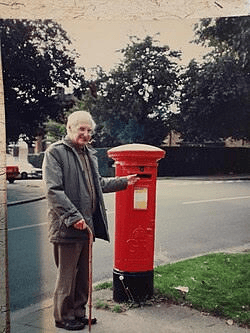
By the way, in 1989, fifteen years after my study at UCL, Brookes asked one of my classmates to visit and ask me to write to him, together with the following photo. So foolishly, however, I did not write to him. He must have liked to talk something very special or important. Still I wonder what it would be. I dare to guess it might be the WWW that began in that year, 9 years later than the original proposal. My hypertextual CCD or CCI might have led to the hypertextual WWW. What else?
Anyway, I wish to come out of my present state of burial even from now on. Why I was buried from the beginning? As you may admit now, Brookes acknowledged my thesis exceptionally well done. After MSc study, I could not continue my study for doctoral degree, but had to return to my employer and serve for three years. Suppose my UCL neighbors cite me frequently, other colleges may invite me to join. Actually, during the period, I attended the UNISIST of Unesco, where an officer of Japanese Ministry of Education asked me to continue doctoral study in Tokyo. After three years, however, I left my employer to join Daewoo Englineering, giving up doctoral study. I was too stupid. My misfortune began.
Now you would understand my extreme stifling and suffocating. Please do me a great favor by helping me come out. I can’t do it alone. A Buddhist monk cannot shave his own hair. Or you cannot scratch your own back. And I wish to collaborate with you upon a new IS matter which must be non-trivial. I wish to receive your response anyway.
Sincerely yours,
Kyung-Youn Park,
now Mark Park,
in memory of “mark and park”
coined by Robert Fairthorne.

